
Eight years of showing up.
Numbers tell part of the story. The rest lives in classrooms, washrooms, mentorship cohorts, on the street with placards, and in the school administrators who signed the MoAs to mount the dispensers.
What the work has touched.
Research and Learning.
Implementation only counts if it teaches. Wazi runs a research and learning track alongside the dispenser model. The 2024 paper, with data from 1,400+ respondents on menstrual health attitudes and practices, is published on SSRN and informs programming, advocacy, and system-level improvements.
of girls surveyed prefer sanitary pads as their primary menstrual product, shaping product procurement across the dispenser network.
of younger students at junior schools choose pads when given access. The youngest cohort needs the most predictable supply.
respondents across Phase 2 schools in Ruaraka, anchoring the published research and policy briefs.
principles of menstrual health, hygiene, and dignity, produced at the Innovating Dignity seminar in December 2025.
The 8 Principles of Menstrual Health, Hygiene and Dignity.
A youth-led framework produced at the Innovating Dignity seminar at American Corner Moi University, December 2025.
Knowledge, Education and Social Norms
Access, Affordability and Market Systems
Product Choice, Quality and User Autonomy
WASH Infrastructure and Environmental Systems
Health and Clinical Care
Inclusion, Equity and Rights
Innovation and Youth Leadership
Governance, Policy and Accountability
Eight SDGs we domesticate.
Every pillar maps to specific Sustainable Development Goals. We do not just talk about them, we run programs that translate them into local action.
Good Health and Well-Being
NCDs, SRHR, mental health, and the dispenser model. Pillar: Health.
Quality Education
AYP Mentorship, Youth Capacity Building, and grassroots education support. Pillar: Education.
Gender Equality
Menstrual access, GBV referrals, women in leadership. Pillar: Health and Education.
Reduced Inequalities
Persons with disabilities, low-income access tracks, vulnerable user prioritisation in the token model. Pillar: Education.
Responsible Consumption
Green the Red, sustainable product use, waste management, behavioural change. Pillar: Environment.
Climate Action
Climate awareness modules, Mazingira Day Mtaani clean-ups, climate murals. Pillar: Environment.
Peace, Justice and Strong Institutions
Civic engagement, youth-led program design, social accountability. Pillar: Advocacy.
Partnerships for the Goals
Be Kids Australia, KU, GYM, Seeds of Change, Giving Light, Wahenga Youth Group, Paper Hearts. Pillar: Advocacy.
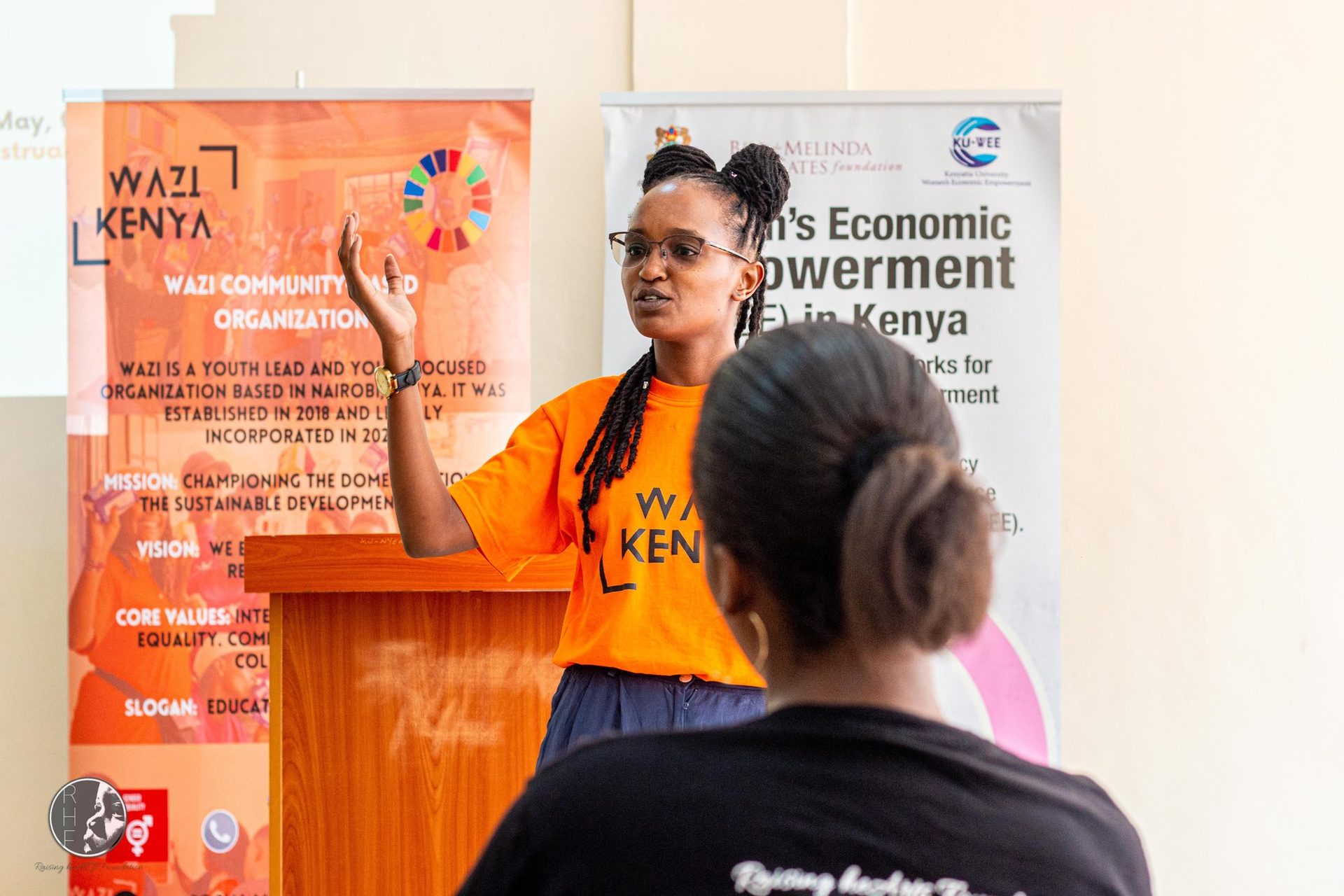
From Ruaraka to the world stage.
Wazi represented at the United Nations Environment Assembly (UNEA-7) and the Global Major Groups and Stakeholders Forum, advocating for youth engagement in environmental governance and menstrual waste management.
An arboretum bench in 2018 led to the floor of the United Nations in 2025. The work moves when young people stop waiting for permission.

Help us reach the next
10,000 users.
Every dispenser stocked, every cohort that starts on time, every research finding that lands in front of a policymaker is downstream of someone who decided to give.